Colleges should engage students before application because students begin forming preferences long before they complete an admissions form. Early engagement creates trust, gives students a clearer sense of fit and belonging, and helps enrollment teams understand developing interest while there is still time to support the decision.
For years, the application served as the moment when many enrollment teams shifted from broad recruitment to more personalized communication. That line is increasingly out of step with how students make decisions.
Students may discover a college through search, social content, a counselor, a friend, an AI answer, or a mailed piece. They compare academic programs and cost, but they also look for evidence of daily life. Who will they meet? Will they fit in? Can they picture themselves there? Will someone answer the question they do not want to ask in a formal admissions setting?
Those questions do not wait for application submission.
Students are building a college list before they enter your funnel
The traditional funnel begins when a student becomes known to the institution. The student journey begins much earlier.
That gap matters more as the pool of high school graduates contracts. WICHE projects that the number of U.S. high school graduates peaked in 2025 and will decline 13 percent through 2041, with significant variation by region and student population. At the same time, students are applying to more colleges and spreading their attention across more choices.
If an institution waits until application to create meaningful interaction, another college may already feel more familiar, responsive, and real.
Earlier does not mean more automated email
Starting engagement earlier is easy to misunderstand. It does not mean taking the same campaign and moving it up by three months. It does not mean increasing message frequency before a student has shown interest.
Early engagement works when it gives the student value.
That value might include:
- Meeting students with shared academic or personal interests.
- Hearing honest perspectives from current students.
- Asking questions in a comfortable setting.
- Exploring communities, activities, and campus experiences.
- Learning what the next step requires without feeling pressured.
The goal is not to accelerate every student toward an application. It is to help students explore with greater confidence and to make the institution available during the part of the journey when impressions are still taking shape.
Belonging can become part of recruitment, not only onboarding
Colleges often think about belonging after a student deposits. Yet a student’s sense of belonging can influence whether they apply, whether they complete the process, and whether they ultimately choose the institution.
Prospective students do not need a promise that college will be perfect. They need credible ways to see the people and experiences that could make the institution right for them.
Peer community is especially powerful here. A student can learn from institutional content, but connection makes that information tangible. A conversation with a current student can turn a general claim about support into a real example. Meeting another prospective student with the same major can make an unfamiliar campus feel more approachable. Seeing active communities can help students imagine not only attending, but participating.
Early engagement creates earlier insight
The benefit is not only emotional. It is operational.
When students have meaningful ways to engage, enrollment teams gain earlier visibility into what matters to them. Patterns of participation can show which topics are drawing attention, which groups are gaining momentum, what questions remain unresolved, and where activity begins to slow.
That insight can improve communication across the funnel. Instead of waiting for a stage change, teams can respond to the student’s current interests and concerns. Marketing can develop content around emerging questions. Counselors can prioritize outreach where a human conversation may help. Leaders can see whether a strategy is creating real participation, not just impressions and clicks.
How ZeeMee helps colleges start earlier
ZeeMee gives students a community where they can begin connecting before application and continue throughout the enrollment journey. Students can discover people and conversations that matter to them while colleges create an experience that feels useful rather than transactional.
The engagement that happens in ZeeMee also gives institutions authentic, first-party insight. Student profiles, interests, community participation, and changing patterns of activity add context to traditional recruitment and application data.
RISE helps enrollment teams make sense of that activity at scale. By combining institutional data with ZeeMee engagement signals, RISE helps teams identify opportunities, monitor enrollment health, and prioritize next steps. Strategy Board helps translate those insights into a coordinated plan so the team can move from “this looks interesting” to “here is what we should do.”
Build momentum before the stakes are highest
Late-stage yield work will always matter. But when a student reaches the final decision with little connection to the institution, every message has to work harder.
Earlier engagement distributes that work across the journey. It gives students time to develop familiarity, find answers, and build relationships. It gives institutions time to learn and respond. Most importantly, it makes the enrollment process feel less like a sequence of transactions and more like a supported decision.
In a smaller, more competitive market, the best time to create momentum is before the application becomes the only signal you can see.
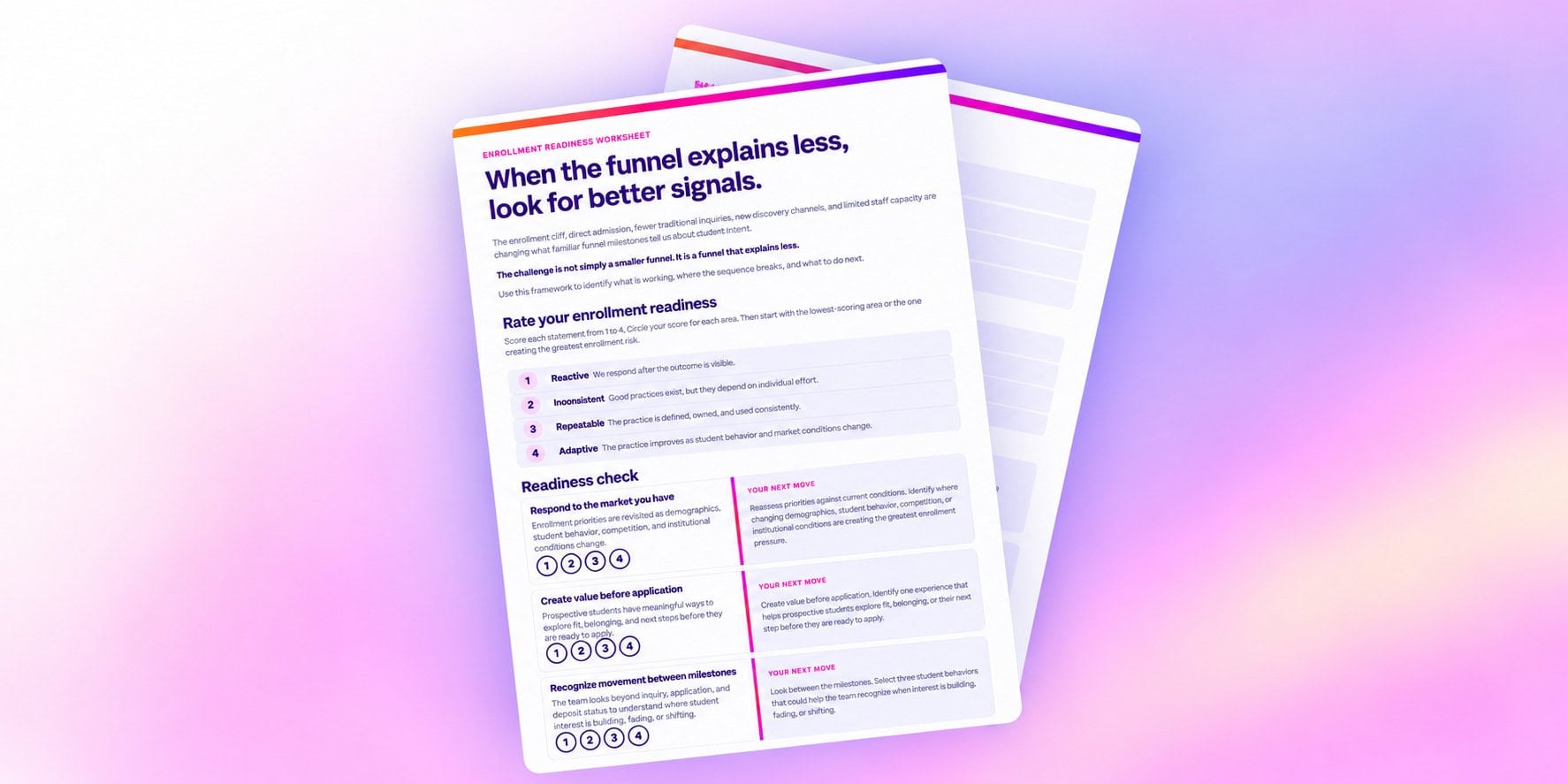
Download our Smaller Funnel Better Signals Action Guide
A smaller funnel means every opportunity counts. Use the Enrollment Readiness Exercise to see where your team is creating early engagement, recognizing student interest, and turning signals into action.