

Over the past year, nearly every conversation I’ve had with enrollment leaders has come back to the same topic: AI.
In this new agentic world, there is enormous opportunity. But there are also real risks if we apply these tools without intention.
The question isn’t whether AI will transform enrollment. It already has.
The real question is: where should it replace human effort and where must humans remain at the center?
This is where ZeeMee has focused its energy and development.
To us, the opportunity isn’t deciding whether to use AI. It’s deciding where it belongs, and where it absolutely doesn’t.
Our latest product, RISE, does just that. It leverages AI to process signals coming from the CRM, student behavior, and the ZeeMee Community, directing counselors each day toward the highest-value activities and outreach. It helps to discern when communication can be scaled, when it can be handed over to an agent, and when it needs to be highly personalized and high-touch.
The organizations that thrive in the next decade will be the ones that preserve human connection in an agentic world and rebuild their tech stacks and workflows accordingly.
A simple framework for thinking about interactions
To make sense of this, I’ve started thinking about enrollment interactions through a simple matrix. Each interaction carries a different level of importance in a student’s life. Some are light and transactional. Others carry enormous personal and financial significance.
To understand which interactions fall into each category, I look at two variables:
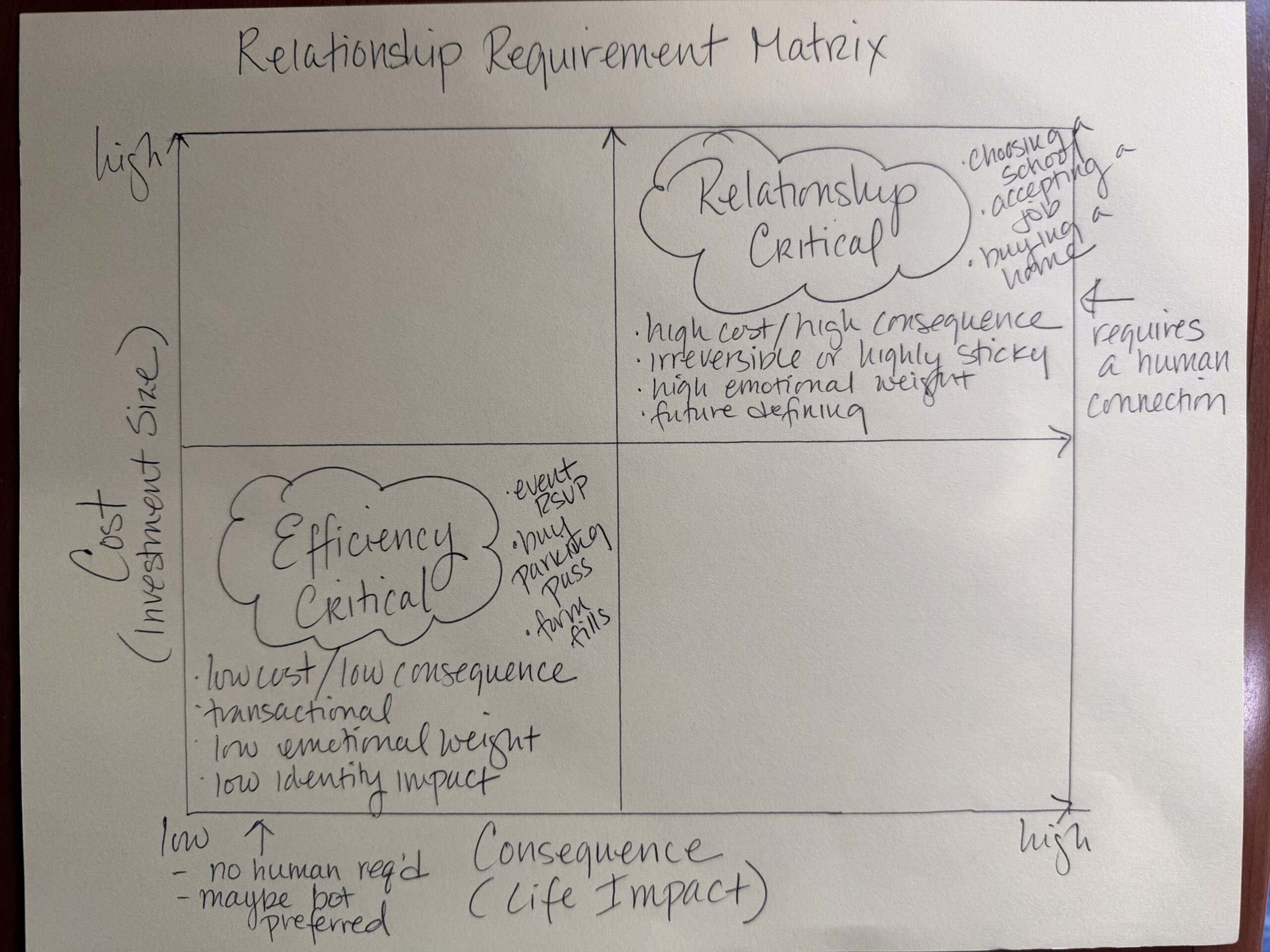
Cost (investment at stake)
How much time, money, or emotional investment does this represent in a student’s life?
Consequence (life impact)
How much does the outcome of this interaction affect the student’s future?
When both cost and consequence are low, the interaction should prioritize efficiency.
When both are high, the interaction becomes relationship-critical.
And relationship-critical moments require people. Not agents. Not automation. People.
Low-cost, low-consequence moments: where automation wins
Many of the interactions in the enrollment journey fall into this category.
Students have logistical questions. They need reminders. They need quick answers and nudges to complete tasks. They even want to gain a little more information about a specific club or program they are interested in, but they need those answers on demand.
These are perfect opportunities for automation. Think about moments like:
- Nudges to complete the FAFSA
- Assistance with form fields or components of an application
- Event registrations
- Understanding program prerequisites
- Updates about visit days and logistics
In these situations, speed and convenience matter far more than who delivers the message. In fact, many students would prefer not to wait for a human response or interact with a person at all.
Agents can provide immediate answers, automate follow-up, and keep students moving through the process without friction.
This is exactly what automation should do.
High-cost, high-consequence moments: where relationships matter
But the enrollment journey is not just a series of tasks. There are moments when a student is trying to answer much bigger questions.

Where do I belong?
Will I succeed here?
Is this the right place for my future?
These are high-cost, high-consequence decisions. They shape identity, community, and opportunity.
Choosing a college is often the largest financial decision a family makes. It determines where a student will live, who they will meet, what they will study, and often the trajectory of their career.
In those moments, efficiency isn’t the priority. Trust is.
Students want to talk to someone who understands them. Someone who can help them picture themselves on campus. Someone who can answer questions that aren’t answered on a website.
And those relationships cannot be created instantly. They must be built over time through many small touchpoints and thoughtful, intentional human interactions.
Knowing which moments are relationship-critical
This is where I think the conversation about AI often goes wrong.
Too often, we all focus on how much we can automate and offload. But an important question to also consider is, “What should never be automated?”
Understanding the difference between efficiency-critical moments and relationship-critical moments is where the magic is. And organizations that do this well will thrive.
They will scale the transactional layers of the journey: the reminders, the updates, the quick answers.
And they will invest their human energy where it matters most: the conversations that help students feel seen, supported, and confident in their decision.
The enrollment future is AI + humans
Automation is going to improve dramatically. Agents will get smarter (and cheaper). Bots will handle more of the operational workload. And students will continue to get support faster.
That’s a good thing.
But as automation handles more of the transactional interactions, something interesting is happening. Students tell us that they are already getting “bot fatigue.” And we’re just at the beginning. We’re already learning that the human moments are more important than ever.
Students don’t choose a school because of the quality of the agent that answered their question. They may be more likely to complete the application steps, which is incredibly valuable. But they will choose a school based on how much they feel they belong there. How welcoming the admissions staff is. How connected they feel to the other entering students. When students connect with a person, that interaction matters. Students expect it to be thoughtful, informed, and meaningful. Those interactions drive decisions.
Soon enough (if we’re not there already) every enrollment tool will promise agents, automation, and scale.
But that’s only half of the opportunity.
The real breakthrough will come from tools that help institutions understand which interactions require scale and which require trust and facilitate both.
That’s the philosophy behind RISE. By combining proprietary student data with AI augmentation, we help teams sift through the noise, identify opportunities for scale and relationship building, and direct human energy exactly where it matters most.
I’m incredibly optimistic about what’s ahead for Higher Ed.
There is extraordinary innovation happening across this industry. If we apply these tools thoughtfully, with the student experience as our North Star, we have an opportunity to transform enrollment outcomes and empower the amazing teams doing this important work every day.
Want to learn more?
Join CEO Vanessa Didyk and Product Manager Courtney Buckner for a live webinar that will explore how enrollment teams can strike the right balance between AI-powered operational intelligence and the human relationships that ultimately drive enrollment.
Where AI belongs in College Admissions – and where it doesn’t
Mar 23, 2026 02:00 PM