

How student intent tracking improves enrollment outreach
Student intent tracking turns clicks and activity into actionable insight. When we read those signals well, we can time our outreach, choose the right channel, and send messages that actually matter to students and families. That is how small moments turn into enrollment, yield, and retention wins.
Late spring is the perfect time to sharpen this work. Teams are wrapping up decisions, managing melt, and planning for fall recruitment while new behavioral data continues to surface every day.
In this article, we walk through clear strategies to move from raw, fragmented behavioral signals to practical, daily actions for your team.
Turning student intent signals into enrollment wins
Student intent tracking has shifted from a nice extra to mission-critical. Application numbers and event registrations are helpful indicators of intent, but they are not enough on their own. You need to understand what students are doing between those key actions.
Right now, late spring brings a fast-moving mix of priorities
- Admits deciding where to deposit
- Deposited students needing continued engagement to prevent melt
- Rising seniors quietly starting their search
If we act on behavior in real time, we can guide each group with better timing and tone. The promise is simple: use intent signals to decide who to contact, what to say, and when to say it.
Decoding the new language of student intent
Student intent tracking is no longer just about inquiry forms or campus tour sign-ups. Today, intent lives in hundreds of actions across your digital world.
Common signals include:
- Repeated visits to key pages like majors, tuition, financial aid, or housing
- Watching campus life or student story videos multiple times
- Returning to the application portal but not completing the next steps
- Clicking email links related to scholarships, deadlines, or next steps
- Engaging with university chatbot questions about cost, programs, or deadlines
- Engagement inside student communities like ZeeMee
- Registering for events but not attending, or attending multiple sessions
How to categorize student intent signals
We can think about levels of intent in three simple buckets:
- Exploratory: early browsing – broad content searches, short sessions
- Comparative: side-by-side checking – exploration of program pages, FAQs, and financial aid content
- Committed: deposit-related actions – housing, next steps, community activity in your ZeeMee admitted student chat
You can score these with a light system, like low, medium, and high intent, tied to behaviors you care about. The gap we often see is this: some data sits in the CRM, but it’s not rich enough, and does not turn into clear, daily steps for counselors and marketers.
That is where opportunities slip away.
Building a shared intent data framework
To make student intent tracking work, we first need a shared framework.
That starts with a map.
List where your data already lives:
- CRM or SIS
- Website analytics
- Virtual events and webinars
- Student community platforms like ZeeMee
- Email and text tools
Next, create a shared classification that both marketing and admissions can use. Keep it simple and human. For example, define tags such as:
- High-intent prospects
- Melt risk
- Needs financial aid support
Then, make sure people can see and act on the data. Instead of long reports, develop:
- Simple easy-to-use dashboards
- Automatic alerts when intent spikes or drops
- Daily priority lists so counselors know who to engage first
The goal is to move from scattered data to a system that is visible, usable, and actionable in real time. When teams can clearly see intent signals and understand what they mean, they can shift from passive reporting to active decision-making.
With that foundation in place, the next step is turning those insights into outreach that reflects where students actually are in their journey.
Intent-driven outreach for prospects and inquiries
For prospects and inquiries, our outreach should match where they are in their thinking, not just where they sit in a static funnel.
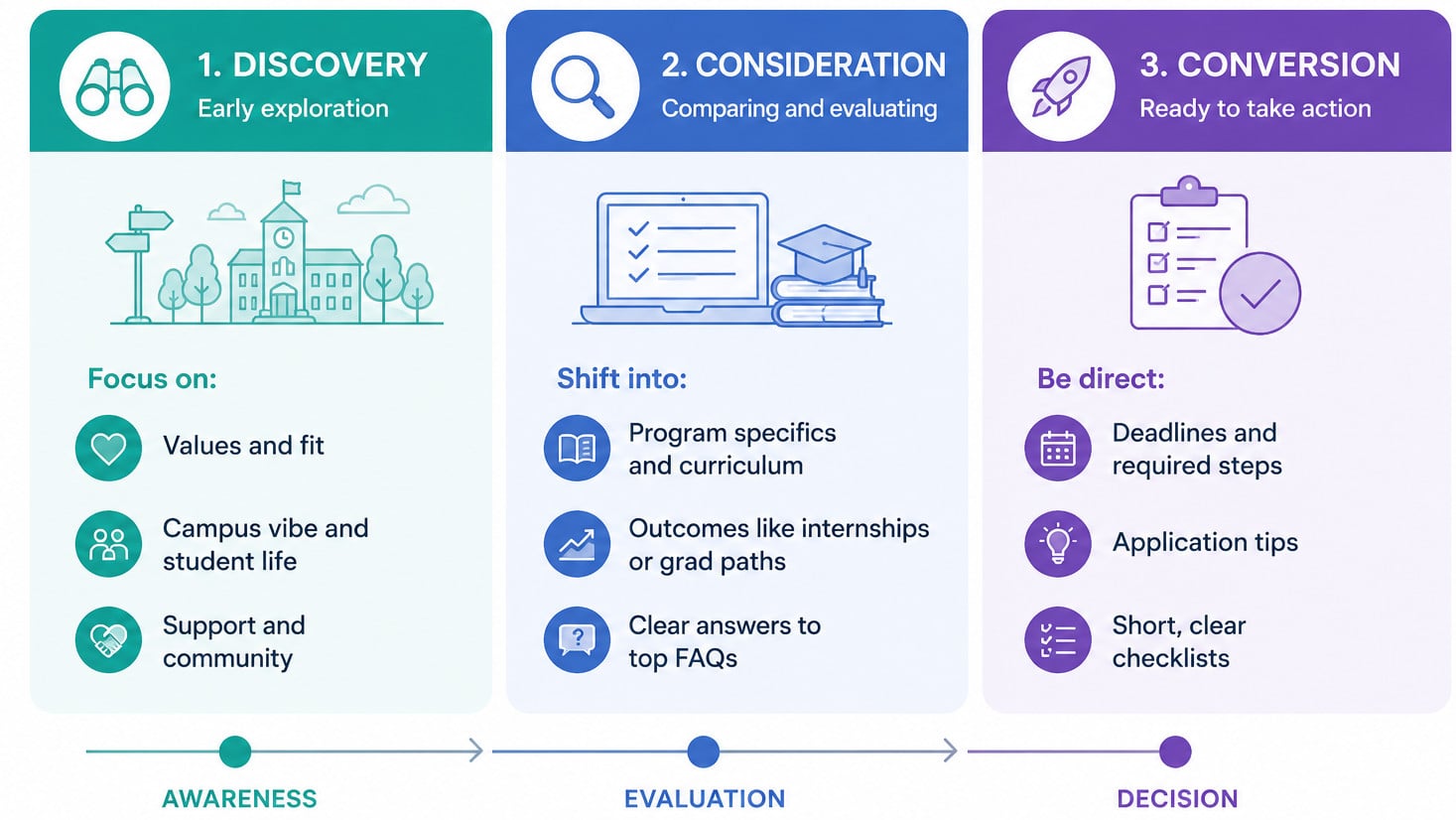
For discovery-stage students, focus on:
- Values and fit
- Campus vibe and student life
- Support and community
For consideration-stage students, shift into:
- Program specifics and curriculum
- Outcomes like internships or grad paths
- Clear answers to top FAQs
For conversion-stage students, be direct:
- Deadlines and required steps
- Application tips
- Short, clear checklists
Student intent tracking also helps prioritize counselor time. High-intent students can get 1:1 calls, personal texts, or invite-only sessions, while lower-intent students move through slower, automated nurture flows.
Smarter messaging for admits and deposited students
At this point in the journey, intent signals shift from guiding interest to sustaining momentum and reducing drop-off after a student has already shown commitment.
Once students move into the admitted or deposited phase, the focus becomes delivering timely, relevant messaging that keeps them informed, reduces uncertainty, and helps prevent melt.
Use student intent tracking to match messages to what they are actually doing. For example:
- Students viewing housing or roommate pages → send housing how-to guides, deadlines, and step-by-step next actions
- Students checking financial aid pages repeatedly → share scholarship opportunities, payment timelines, or FAFSA support resources
- Students engaging with major-specific content → send career outcomes, internship stories, or faculty highlights for that program
Trigger campaigns from real-time behavior. If a student:
- Students who have not completed key next steps → trigger gentle reminder nudges with clear checklists and deadlines
- Students showing drop-off in engagement → send re-engagement check-in messages to gauge how a student is feeling
- Students have not visited campus → invite them to a campus visit or an event experience day.
That is a sign to check in with a gentle, personal nudge.
Across email, SMS, your ZeeMee community, and social, your plan should feel like one clear path to campus. Short, steady, and reassuring messages beat long, scattered updates.
Perfecting timing and cadence across the funnel
Timing might be the quiet hero of student intent tracking. The same message can land very differently depending on when a student sees it.
First, map your “moments that matter”:
- Application start and completion
- Financial aid and verification steps
- Housing selection and roommate matching
When you see intent spike, such as multiple logins in a short time or repeat visits to one page, speed up your cadence for a bit. When students show steady, healthy engagement, slow down and keep messages lighter to avoid fatigue.
Across the year, your timing strategy will shift:
- Late spring and summer: focus on yield, melt risk, and pre-arrival questions
- Early fall: build search and early inquiry interest using fresh behavior data
- Late fall and winter: guide students through apps and FAFSA completion, based on what they are doing in your systems and communities
Student intent tracking keeps these shifts grounded in real behavior, not just dates on a calendar.
From data to daily practice in the next 30 days
To pull this all together, focus on a simple 30-day plan:
- Audit where your intent data lives and who can see it
- Identify and develop key intent tags like melt risk or high-intent prospects
- Build resources to visualize the data and develop a clear communications plan to guide execution.
Start small, measure things like response rates and conversion from one stage to the next, then adjust. The goal is steady progress, not a huge rebuild all at once.
At ZeeMee, we see every day how student communities and real-time signals can turn guesswork into clear next steps. When you blend behavior data, human judgment, and a community-powered space where students already spend their time, your outreach, messaging, and timing all work together to support stronger enrollment, yield, and retention results.
Turn student interest into action with intent insights
If you are ready to move beyond surface-level metrics and truly understand which students are most likely to enroll, we can help. At ZeeMee, we use data-driven student intent tracking to reveal real-time interest and guide smarter outreach. Partner with us to prioritize your efforts, personalize communication, and support students at exactly the right moments in their journey.
Let’s work together to turn curiosity into commitment.